Overview
The Example Posts Library helps Asteria Engine recognise the tone, structure, and content patterns your brand wants to repeat. A well-maintained library gives AI-assisted drafts a clearer reference for your preferred style.
If your AI-generated content feels generic, inconsistent, or too far from the brand voice, the quality of your example library is one of the first places to look.
What Example Posts Are Really For
Example posts give the system a real reference set for:
- tone and vocabulary
- caption structure
- hashtag habits
- CTA style
- content rhythm and pacing
- visual expectations where relevant
Asteria Engine uses these posts as style references rather than text to copy. Choose examples that clearly represent your brand’s preferred voice and content structure.
What Makes a Strong Example Library
Quality matters more than volume
A smaller set of strong examples is far more useful than a large set of average or off-brand posts.
Choose posts that are:
- clearly representative of your real voice
- commercially useful, not just “creative”
- aligned with how you want future content to sound
- tied to formats and topics you actually intend to keep using
Good examples usually have one or more of these qualities
- above-average engagement
- strong message clarity
- clear audience relevance
- a CTA that feels natural
- unmistakable brand tone
If a post performed well for a reason that no longer fits the brand, do not keep it just because it once got attention.
Adding Example Posts
Open Examples Library from the main navigation. This is the workspace's dedicated examples workflow.
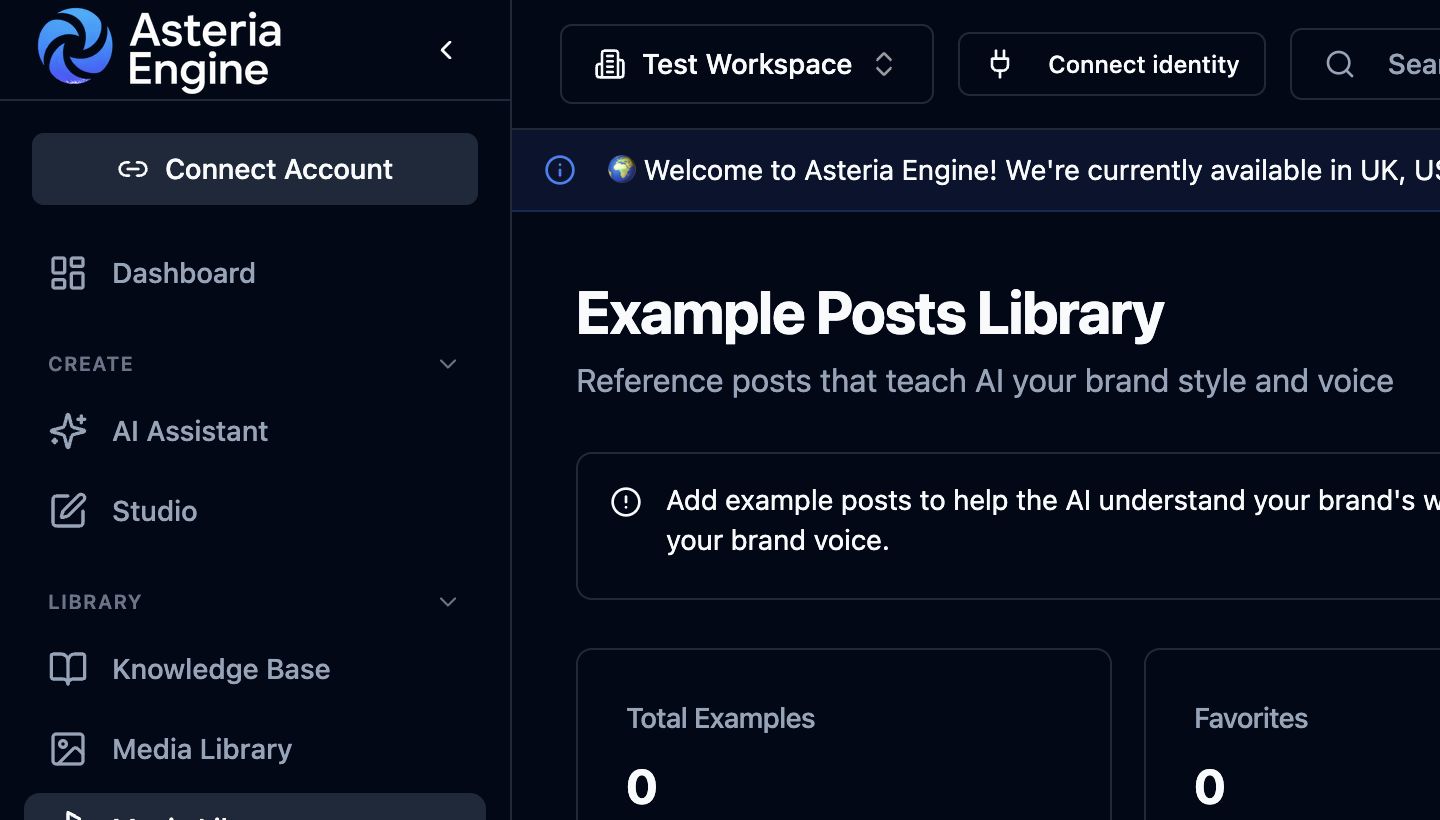 The Example Posts Library stores reference posts that teach Asteria Engine your brand style and voice.
Typical add flow
- click Add Example
- paste the caption text
- choose the original platform
- optionally upload the related image if relevant
- save the example
Where an image is supported, keep uploads clean and representative. The example library is more useful when it reflects the kind of visual and verbal output you actually want repeated.
How Many Examples You Really Need
As a practical baseline:
- 10–15 examples gives the system a starting signal
- 20–40 examples usually gives much better consistency
- 40+ examples can produce stronger brand replication if the library stays curated
There is no point chasing a large number if the set becomes noisy, outdated, or inconsistent.
Use Platform-Specific Examples Where Possible
Different platforms reward different tone, structure, and pacing. If your team publishes across multiple channels, try to include examples from the channels that matter most.
This helps the system understand that:
- LinkedIn may need a more professional structure
- Instagram may need more visually led caption logic
- X may need tighter hooks and more compressed wording
- YouTube-related content may need a different descriptive structure again
Cross-platform quality improves when examples reflect real platform behaviour rather than copied-and-pasted captions reused everywhere.
Favourites and Prioritisation
If the interface allows favouriting, use it deliberately. Favourite posts should represent the clearest examples of how the brand should sound.
This is useful when you want to bias the system toward:
- a specific tone
- a stronger CTA style
- a preferred structure
- the most commercially relevant examples in the library
Do not favourite everything. That destroys the signal.
Managing the Library Over Time
A strong example library is curated, not left to drift.
Good maintenance habits
- add new examples after clearly strong performance periods
- remove examples that no longer represent the current brand
- review the set when offers, audience, or positioning changes
- keep examples aligned with how you want the brand to sound now, not last year
Signs the library needs cleanup
- AI output feels inconsistent
- examples cover too many unrelated tones
- old campaign language no longer fits the business
- high-performing but off-brand posts are still shaping the model
How the AI Uses Examples
Asteria uses examples as a training signal for style and structure, not as a copy source.
That means the system can learn from:
- sentence length patterns
- vocabulary choices
- punctuation habits
- tone intensity
- CTA positioning
- hashtag density
The better your examples, the less correction you should need after generation.
Common Mistakes
Mistake 1: adding weak or generic posts
If the library is full of average content, the AI has no strong signal to learn from.
Mistake 2: mixing contradictory voices
If half the examples sound formal and the other half sound like a completely different brand, the output can become unstable.
Mistake 3: keeping outdated posts because they once performed well
Good historical performance does not automatically mean the post still reflects the current brand.
Mistake 4: ignoring the library after initial setup
The library should evolve as the brand, campaigns, and content standards evolve.
When the Library Is Doing Its Job
You should start to notice improvements such as:
- stronger first drafts
- less editing for tone
- more natural CTA structure
- fewer generic phrases
- more consistency across generated posts
If none of those are happening, the problem may be weak examples, weak brand settings, or weak prompts. Review all three together.
For the broader generation workflow, see the AI Content Generation Guide.
Troubleshooting
The AI still does not sound like the brand
Check:
- whether the examples are actually strong enough
- whether the best examples are clearly represented
- whether the library includes the platforms you care about most
- whether brand settings are also complete
You cannot find an example later
Use search, filtering, and any available platform segmentation consistently. A library only creates value if the team can retrieve the right examples quickly.
Image upload issues
If an example image fails to attach, confirm the file is in a supported format and within the expected size limits, then retry with a cleaner source file if needed.
Recommended Next Steps
The Example Posts Library becomes far more valuable when used alongside:
Review the library regularly so it continues to provide current, high-quality examples alongside your prompts and brand context.